Ğ1 (June) : a free and eco-friendly crypto-money [̲̅$̲̅(̲̅1)̲̅$̲̅]
· Updated · 3 min read · by Adrien Lopez
While most crypto-currencies burn huge amounts of energy, Ğ1 (pronounced "June") is a free, low-energy currency based on the Relative Theory of Money and a Web of Trust, where every member co-creates money through a universal dividend. Let's have a look into it!
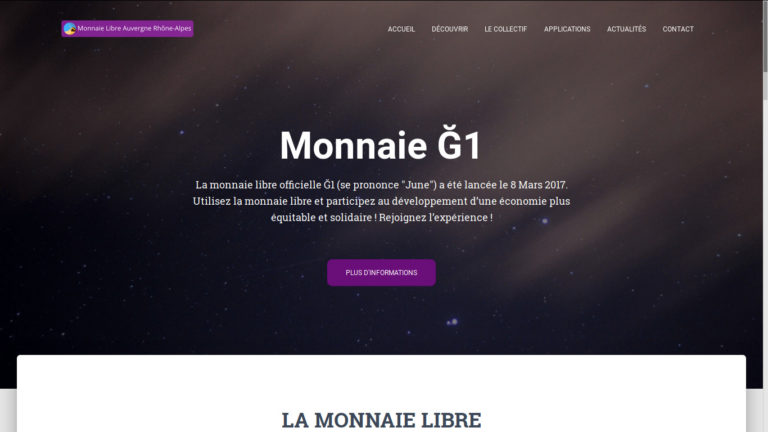
When we talk about crypto-currencies, two images come to mind: speculation, and gigantic mining farms consuming as much electricity as entire countries. Ğ1 (pronounced "June") takes a completely different path. It uses a blockchain, but without energy-hungry mining, and its main innovation is not technical: it is a new way of creating money.
The Relative Theory of Money
Ğ1 is the first currency built on the Relative Theory of Money (TRM, Théorie Relative de la Monnaie), published in 2010 by the French engineer Stéphane Laborde. The theory is available for free, in English, on trm.creationmonetaire.info.
Its starting question is simple: who should create money, and how?
- In our current system, money is mostly created by commercial banks when they issue loans, and by central banks.
- In Bitcoin, money is created by miners as a reward for securing the network, which favours the early adopters and those who own the most computing power.
The TRM proposes a third way, based on four economic freedoms, including the freedom to produce value and to exchange in the currency of your choice, and on one principle: symmetry in time and space. Every human being, today and in the future, should have the same share in the creation of money.
The Universal Dividend
In practice, each member of the Ğ1 currency receives every day a Universal Dividend (UD): a fixed share of new money. The amount is recalculated periodically so that the money supply grows by about 10% per year, a rate derived from human life expectancy in the theory.
Consequences:
- Money is not created by a bank or a company, but co-created equally by all members.
- A newcomer who joins in ten years receives the same relative share as someone who joined at the launch. There is no "early adopter jackpot".
- Prices are best measured in UD, a unit that stays stable relative to the total money supply.
A Web of Trust instead of mining
To prevent anyone from creating fake accounts and receiving multiple dividends, Ğ1 uses a Web of Trust:
- to become a member, you must be certified by at least five existing members who know you personally;
- certifications expire and must be renewed, and each member can only issue a limited number of them;
- the network checks that every member is close enough to the rest of the web.
The blockchain is secured by members' computers running the free software Duniter. Blocks are written in turn by members, with a very light proof of work adjusted to prevent any single node from dominating. A Raspberry Pi is enough to run a node: the energy footprint is negligible compared to Bitcoin.
Using Ğ1 in practice
- Wallets. The most popular clients are Cesium (web and mobile) and its successors, all free software.
- Marketplaces. Members exchange goods and services on ğchange and at local markets ("ğmarchés"), mostly in France, Belgium and Spain.
- Community. Local groups organise meetups to meet each other and exchange certifications.
You can use Ğ1 without becoming a member (you just won't co-create the dividend), but the real experience comes from joining the Web of Trust.
Limits and open questions
Ğ1 is a fascinating experiment, but let's stay lucid:
- the economy is still small and mostly based on second-hand goods and local services;
- the Web of Trust requires meeting people physically, which is slow (and that is intended);
- the currency has no legal tender status and should not be seen as an investment.
Why it matters
Ğ1 shows that a blockchain does not have to be an ecological disaster, and that money creation is a political and technical design choice, not a law of nature. It is also a beautiful example of a free software project, entirely developed by volunteers, licensed under open licences and governed by its community.
Resources
- Relative Theory of Money (English)
- Duniter, the Ğ1 software
- Cesium wallet
- Monnaie libre (French portal)
Interested in decentralised alternatives? Read my post on decentralised social media platforms.